Pricing at Awana Software is based on an agreed project scope. The ranges below are starting points for discussion, with a written quote after requirements are reviewed.
Clear scope. A considered quote.
These are indicative starting budgets, not fixed-price promises for every requirement.
Small, clearly scoped projects
Custom .NET applications
Suitable for discussing a focused business tool or a limited first version with agreed screens, records and reports.
- Individually defined requirements
- .NET application development with SQL Server where needed
- Agreed functionality and review process
Simple informational sites
Basic WordPress websites
For a basic business website with an agreed number of informational pages and content. Dynamic features are quoted individually.
- Agreed page structure and responsive layout
- Business details and service information
- Clear contact and enquiry paths
All ranges are in Indian rupees (INR). Final pricing depends on requirements. Larger or more complex projects can exceed these ranges.
What changes the price?
- Number of pages, modules, screens and user roles
- Complexity of business rules and reports
- Imports, migration and external integrations
- Design, content and delivery requirements
- Deployment, training and ongoing support needs
Make room for the whole project.
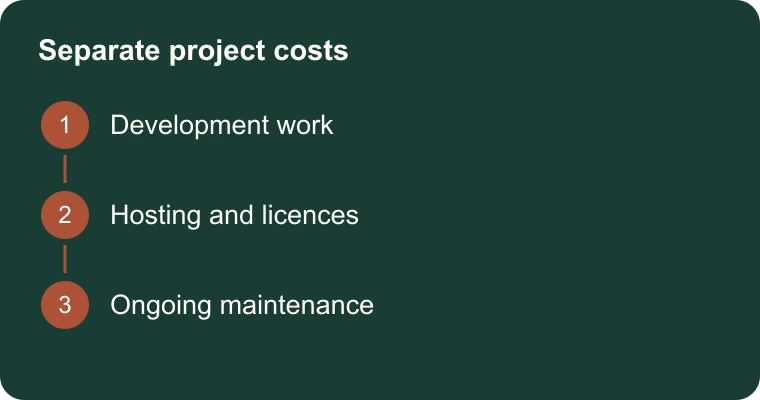
Domain registration, hosting, paid plugins, third-party services, database or software licenses, maintenance and applicable taxes are clarified separately in the quote.
Source-code handover, ownership or licensing terms, payment milestones, revisions and post-delivery support are agreed before starting. New requirements after scope approval may change the cost and timeline.
From enquiry to delivery
Share your requirements
Describe your business, current process, essential features, budget and preferred timeline.
Review the proposal
Confirm deliverables, exclusions, dependencies and commercial terms in a written quote.
Build and review
Develop and test the agreed features, then complete handover and discuss any future work.
Can you build enterprise-level software for ₹10,000?
The aim is careful, professional development at an accessible price. A ₹10,000 starting budget is only realistic for a small, well-defined application. A full enterprise system with many modules, integrations or complex operational needs requires a separate estimate.
How long will my project take?
The timeline is estimated after reviewing the scope and dependencies. Page count, feature complexity, content readiness and review turnaround all affect delivery.
Can I add features later?
Yes, future enhancements can be discussed and quoted separately. Planning a focused first phase helps prioritise immediate needs.
Let’s find the right scope for your budget.
A clear description is all you need to start the conversation.
Pricing: compare the complete scope
A price is useful only when the deliverables are clear. Two projects described as “inventory software” can have very different needs. One may require a small stock register and a report; another may involve multiple locations, approvals, migration and integrations. The quote should specify which version is being developed.
Separate development from running costs
Hosting, domains, paid plugins, database licences and external services may involve separate or recurring charges. Discuss who purchases these services and who controls the accounts. Backups, updates and support also need an agreed arrangement. A low development price does not automatically cover every future operating cost.
Agree what acceptance means
List the screens, fields, business rules and reports included in the first release. Define how you will check them and what sample data is needed. Set expectations for revisions and clarify how additional features will be estimated. This keeps the budget connected to useful, testable work.
For a website, content readiness, page count and design requirements affect the effort. For software, the number of workflows and data relationships is often more informative than a simple screen count. Existing spreadsheets or anonymised report layouts can make the estimate more precise.
Quotes are discussed directly with Yatendra Kumar Awana. Enquiries are welcome from Noida, Delhi NCR, Uttar Pradesh, across India and internationally. For overseas projects, currency, communication times and payment arrangements are agreed in the proposal. Send your requirements to request an estimate.

More detail for an informed decision
Pricing: understand the small-application range
The ₹10,000–₹25,000 range is intended for a small, clearly scoped custom application. A useful starting scope might address one operational need with an agreed set of records, screens and reports. It should be possible to describe the expected behaviour and test it with representative examples. The range does not establish a fixed price for any application described with a broad label such as inventory, ERP or production management.
Pricing changes with the work required. More user roles, complex calculations, integrations, migration or extensive reports can increase the effort. Before comparing quotes, check that they describe the same deliverables. A proposal should explain what is included, which dependencies must be supplied and what is outside the first phase. If the available budget is smaller than the desired system, discuss a focused initial release rather than assuming all features can be included.
Pricing: understand the basic-website range
The ₹4,000–₹6,000 range applies to a basic informational WordPress website with an agreed page count and content. Its purpose is to introduce the business and provide a clear contact path. The estimate depends on what needs to be designed, written, arranged and tested. A website with additional visitor accounts, complex catalogues, e-commerce or integrations requires a separate assessment.
For website pricing, clarify who supplies the text, images and business details. Mention an existing domain, hosting account or design that must be retained. Recreating a large website, preparing extensive new content or transferring an existing installation can add work. WordPress itself is an open-source platform, but hosting, domains, commercial themes, paid plugins and external services may still have costs. The official WordPress website explains the platform independently of Awana Software’s development charges.
Pricing: separate one-time work and recurring costs
A development fee and the cost of operating a system are different parts of the budget. Hosting and domain registration may renew periodically. A database edition, plugin or third-party service may have its own licensing arrangement. Support and maintenance may also be priced separately. Ask which costs are paid to Awana Software, which are paid directly to another provider and who controls the corresponding accounts.
The pricing discussion should identify these dependencies before you approve the project. A low initial fee should not hide a necessary recurring service. Likewise, a higher estimate may include work that another proposal excludes. Compare the full scope, operating arrangement and handover terms. If a third-party product is required, its current price and licensing terms should be reviewed for the actual deployment rather than assumed from a general website example.
Pricing: use a written feature list
A feature list should describe what the user can do and what result they should see. “Order report” is a starting point, but the useful details include the filters, date range, columns and totals required. “Contact form” should identify the information collected and where the enquiry goes. These examples help turn an informal idea into work that can be estimated and checked.
For accurate pricing, separate essential features from later improvements. Include the assumptions that affect delivery, such as timely content approval, access to an existing system or availability of sample data. Decide how revisions and additional requests will be handled. If a requirement changes after the scope is agreed, the effect on effort and timeline should be discussed before the change is treated as included work.
Pricing: agree review, payment and handover terms
The proposal should state the deliverables, expected dependencies and commercial terms. Payment milestones, review arrangements, source-code ownership or licensing, deployment and support should be agreed before development begins. These matters depend on the specific project; this website does not set a universal payment schedule or promise a particular maintenance period for every client.
Review the acceptance examples as well as the feature names. A business application should be checked against realistic tasks and reports. A website should be reviewed for the agreed pages, contact route and mobile layout. Clear approval responsibilities can avoid confusion about when work is ready. Pricing is easier to assess when both the deliverables and the process for confirming them are written in language that the business understands.
Pricing: request a useful estimate
Send a short description of your business, the current problem, the essential features and the result you need. Mention an approximate budget and preferred timeline. An anonymised spreadsheet or report layout can help explain software requirements; a page list can help explain a website. Avoid sending passwords, customer records or confidential commercial information in the first enquiry.
Awana Software is based in Noida, Uttar Pradesh, and welcomes enquiries from Delhi NCR, across India and internationally. For remote projects, communication times, currency and payment arrangements are discussed in the proposal. Final pricing follows the requirements review. You can contact Yatendra directly by email, phone, WhatsApp or the website enquiry form. The first step is to establish a realistic scope that connects the available budget with a useful business outcome.
For platform background, read the official WordPress introduction. Platform information does not include Awana Software’s development fee or third-party running costs.